Commercial water leak detection. Connected to your team.
A commercial water leak detection system connected to your facilities team. Place probes at vulnerable locations and bring detected water detection into Monaire’s platform.

Cover the places a routine walk-through can miss.
1
Mechanical rooms
Place near water heaters, pumps and other water-using equipment where escaping water can collect.

2
Under sinks and fixtures
Add sensing inside cabinets or around plumbing connections.

3
Remote and low-traffic areas
Monitor selected locations that staff visit infrequently, so water events can be investigated between inspections.

Water events with a location and a next step
Give the team context to investigate the source and follow the response through.
Place anywhere
Position sensors where water leaks are expected. Long range wireless makes installation a breeze.

Instant detection
Get alerted as soon as there is a water leak event.
Investigate the event
Review water-leak issues, automate work-order follow-up for the team.

Confirm resolution
Post resolution ensure that there is no longer any water leak.


Monaire Water Leak Sensor
Easy to install, reliable wireless transmission
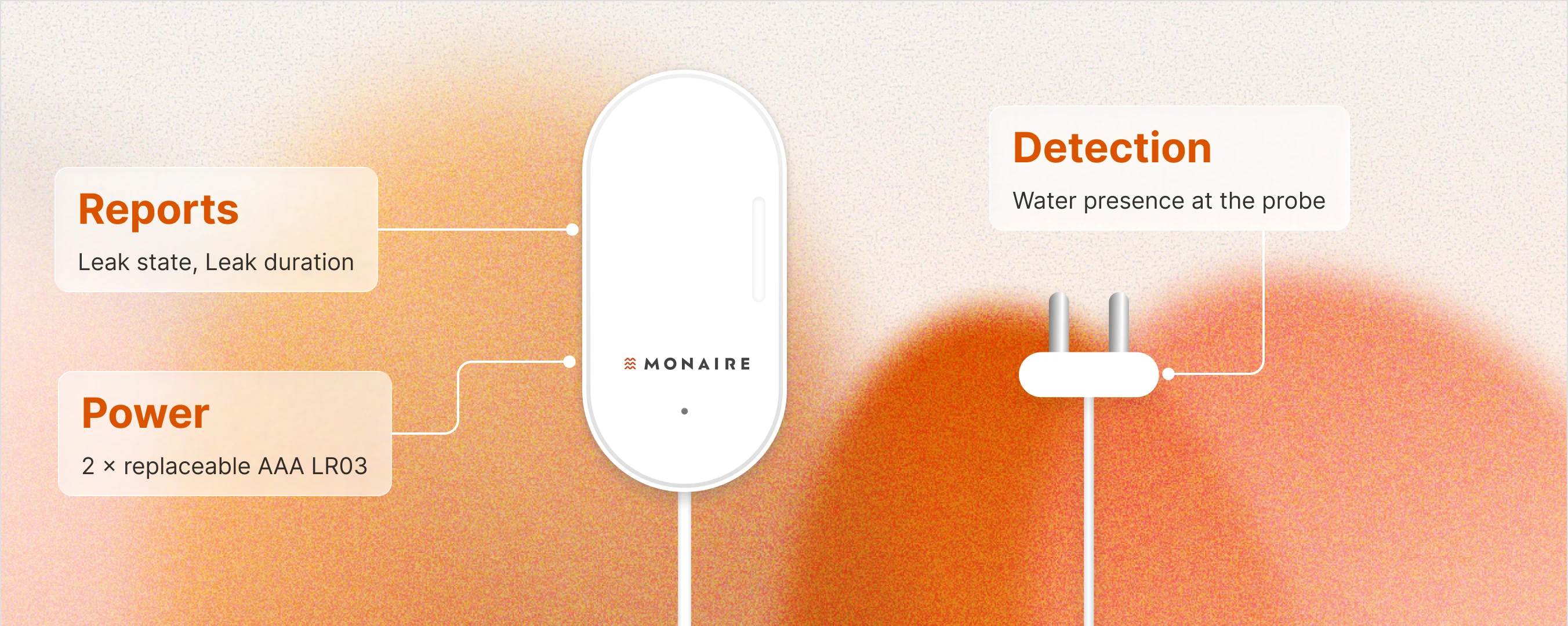

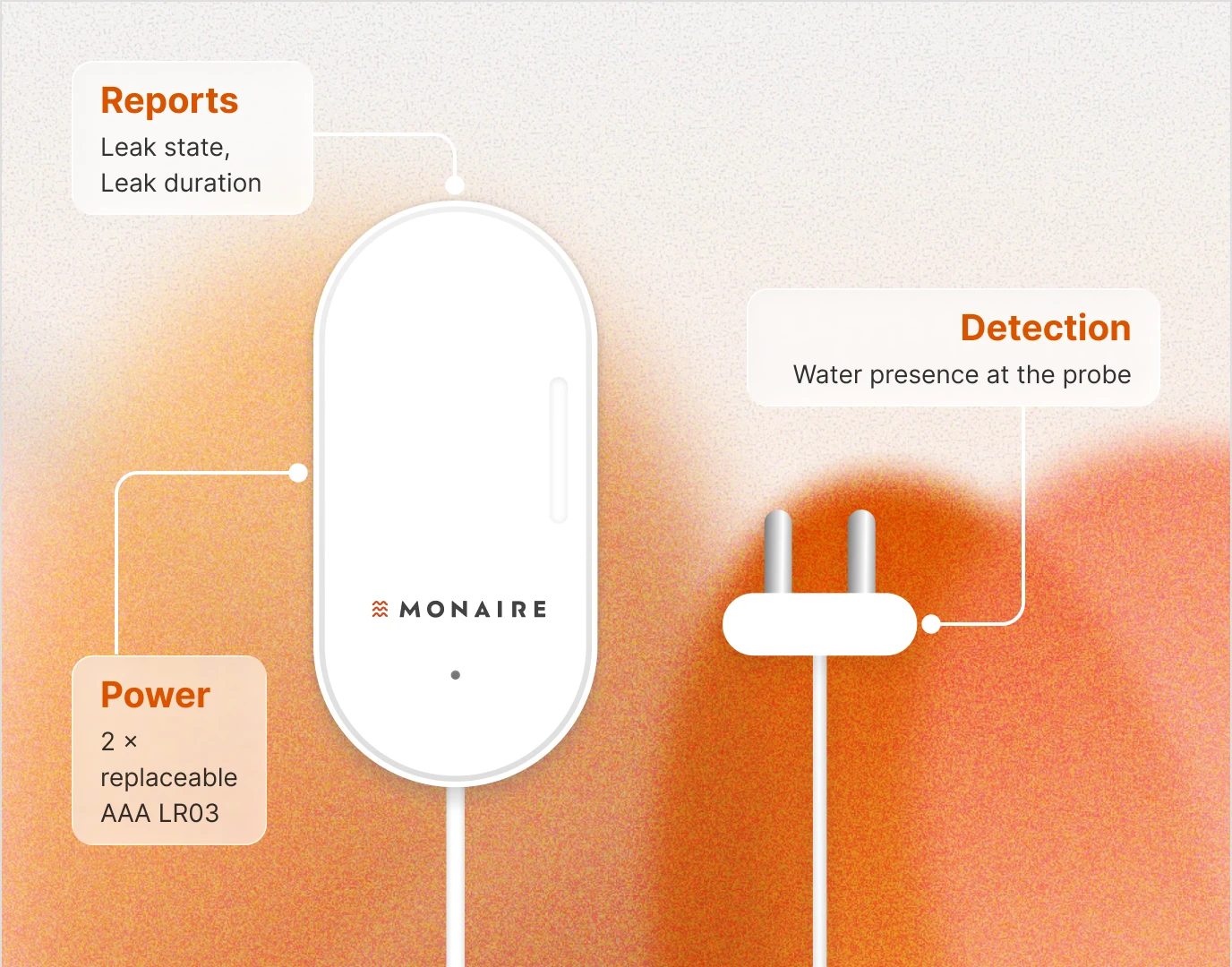
How does Monaire’s commercial water leak detection work?
The Monaire Water Leak Sensor detects water reaching external probes placed at selected risk points. It connects through the Monaire AI Hub (cellular gateway). Monaire associates each water event with its building and installation area so the team knows where to investigate.
Where should water leak sensors be installed?
Place probes where water is likely to collect near plumbing or equipment, such as beneath sinks, near water heaters or in mechanical areas. Choose locations based on leak risk and drainage paths. Mount the main sensor body in a protected, dry position above the detection point.
Can the sensor detect a hidden leak inside a wall or pipe?
The Monaire Water Leak Sensor detects water when it reaches its external probes. It does not locate a leak inside a concealed pipe or wall, and it cannot identify the source of the water on its own. Probe placement determines which risk points are covered.
What happens when water is detected?
A reported water event appears in Monaire with the associated building and installation-area context. Configured issue and work-order settings support follow-up by the facilities team. The deployment should establish who responds and how the event is checked and resolved.
Does Monaire automatically shut off the water supply?
Monaire water leak detection alerts your team to detected water and supports follow-up. It does not include an automatic shutoff valve. Water isolation requires the appropriate site procedure or a separately specified valve-control solution.
Does the sensor measure water flow, pressure or consumption?
No. This offering detects the presence of water at its probes. It does not measure flow, pressure or water consumption, and it does not provide complete pipe diagnostics.
Does water leak detection need a separate gateway?
Monaire Water Leak Sensors connect through the Monaire AI Hub (cellular gateway). Monaire checks whether an existing Monaire AI Hub can support additional sensors and confirms device coverage during deployment.
Is the Monaire Water Leak Sensor waterproof?
The Monaire Water Leak Sensor’s main body is not waterproof and must remain in a protected, dry location. Only the external probes should be placed at the water-detection point. Installation should keep the sensor body above areas where water may accumulate.
What batteries does the water leak sensor use?
The Monaire Water Leak Sensor comes with two replaceable AAA LR03 batteries. Battery life depends on battery type, reporting frequency, connection conditions and water-event activity. Include battery-status checks and replacement in the site’s maintenance plan.
How should a water leak detection deployment be tested and maintained?
Run a controlled water-detection test at each probe location and confirm that the correct location appears in Monaire. Verify the response process, keep the main body dry, and periodically check batteries and connectivity. Reassess probe placement when equipment or plumbing changes.
Still have questions?
Can’t find what you are looking for? Reach out to our team